
The You Want Pure Air buying guide
Choose the right product for your room, your routine and the problem you actually want to solve.
Compare air purifiers, air quality monitors, dehumidifiers, mattresses, desks and sofas with practical recommendations, real product examples and the details that matter before ordering. Start with your main need below, or go straight to the SA600 versus Blast Mini comparison.
How we help you choose at You Want Pure Air
Behind You Want Pure Air are Jim Coulthard and Valerie O’Mahony. Read their story and the thinking behind the store.
Our starting point in this guide is the fit between your needs and the product: what it does, where it will go, how you will use it and what it will cost to own. Send us those details when asking for advice, rather than choosing on a headline specification alone.
This is a retailer’s buying guide featuring products we sell, not an independent whole-market test. Recommendations are based on published specifications and intended use, not a claim that we have personally tested every product. The product links and manufacturer sources let you check the details.
1. What would you like your home to do better?
Choose the main need first. You do not need to buy across every category to make a useful improvement.
| Your priority | Start here | What it does | Check before choosing |
|---|---|---|---|
| Filtering airborne particles | Air purifiers | Filter room air while running. | Room volume, clean-air delivery at a usable fan speed and replacement filters. |
| Understanding your indoor air | Air quality monitors | Show readings and trends for the sensors included. | Measurements needed, intended environment and connectivity. |
| Reducing excess moisture | Dehumidifiers | Collect moisture from room air. | Room temperature, extraction conditions, drainage and the cause of damp. |
| Changing your sleeping setup | Demko beds and mattresses | Offer different support, construction and material options. | Firmness preference, selected cover, dimensions and base compatibility. |
| Making room to work comfortably | Office desks | Provide different layouts and adjustment options. | Working height, desktop size, equipment load and cable reach. |
| Updating your living room | Sofas | Provide different seating layouts, fabrics and mechanisms. | Seat feel, footprint, care instructions and delivery route. |
A monitor measures; a purifier filters; a dehumidifier removes moisture. One is not automatically a replacement for the others. Start with the function that matches the issue you want to understand or change.
2. How do I choose an air purifier for my room?
Start by comparing the compact SA600; consider the Blast Mini Mk II when higher clean-air delivery is the priority. The right choice depends on room volume and the fan setting you are comfortable using, not simply which model has the bigger maximum number.
CADR means clean air delivery rate: a measure of particle-cleaning performance, usually expressed in cubic metres per hour (m³/h). It is not the same as the fan’s raw airflow. HEPA means high-efficiency particulate air: a filter type for particles, rather than a guarantee of gas removal. Both models below list H13 HEPA filtration.
The EPA’s air-cleaner guide explains sizing by CADR and the distinction between particle and gas filtration. Filtration supplements source control and ventilation; it does not replace them.
- Measure the space. Multiply room length × width × ceiling height. Include the connected area in an open-plan layout, not just the corner where the purifier will stand.
- Choose the filtration you need. For particles, compare HEPA filtration and CADR. For certain gases or odours, check the specific activated-carbon option as well.
- Compare everyday operation. Ask for CADR, noise and power at the same operating setting. Maximum CADR and minimum noise are not a simultaneous performance promise.
- Plan placement and maintenance. Leave the clearances in the manual, keep air inlets unobstructed and check replacement-filter compatibility.
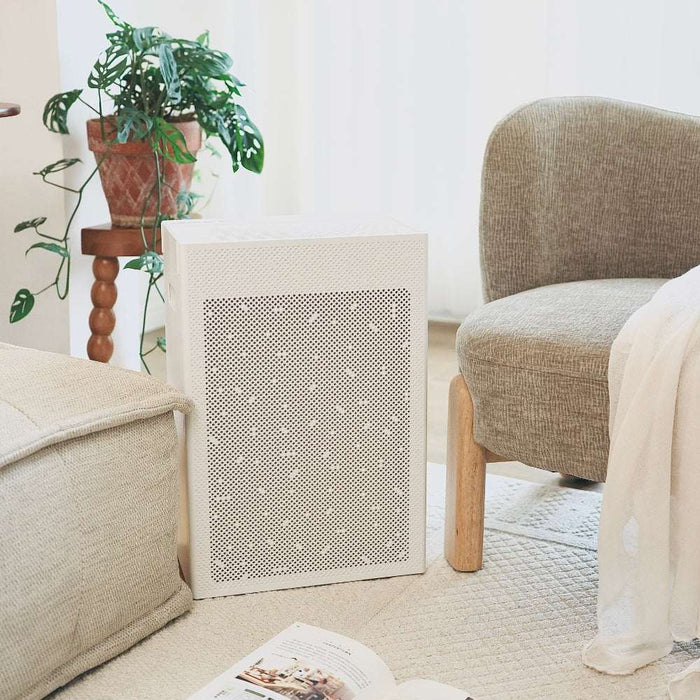
Shortlist the SA600 when…
You want a compact purifier for a bedroom, home office or living room, and its clean-air delivery meets your room’s needs at an acceptable fan setting.
Consider an alternative when: the performance you need exceeds what it can deliver at a noise level you can live with.
Check SA600 options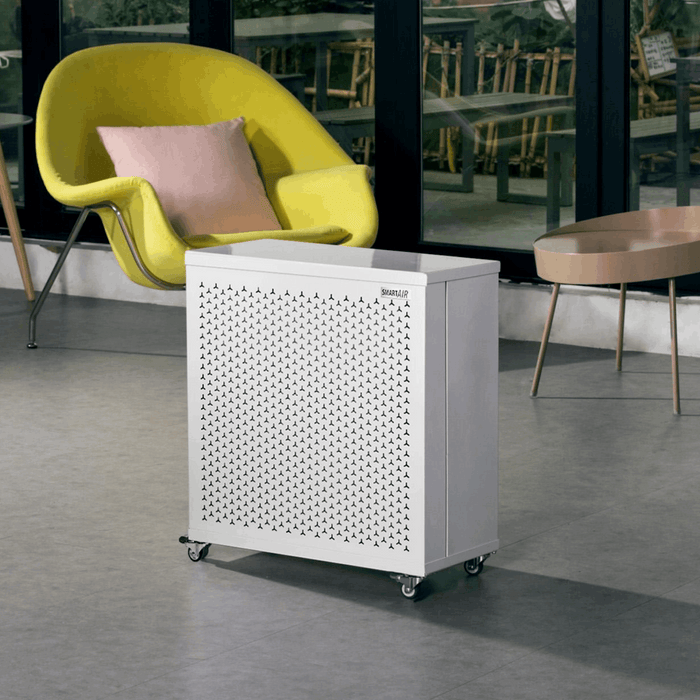
Shortlist the Blast Mini when…
Your comparison calls for higher clean-air delivery and you have room for a heavier, wheeled metal unit. It is worth considering for a larger connected living or working space.
Consider an alternative when: compact size, lifting between floors or a particularly low noise requirement is the deciding factor.
Check Blast Mini options
Plan the cost of ownership
Price the full set of compatible replacement filters, including carbon when selected. Similar-looking filters are not automatically interchangeable.
Follow the maintenance instructions; do not assume a HEPA filter is washable. See the running-cost example before comparing purchase prices alone.
Find replacement filtersSmart Air SA600 versus Blast Mini Mk II
On a small screen, swipe the table sideways. Figures are published specifications, not our own laboratory measurements.
| Compare | Smart Air SA600 | Smart Air Blast Mini Mk II |
|---|---|---|
| Maximum particle CADR | 508 m³/h. | 740 m³/h. |
| Controls | Five fan speeds; manual operation. | Manual operation; no app or Wi-Fi required. |
| Published noise range | 16–51 dB(A), depending on setting. | 36–49 dB, depending on setting. |
| Positioning and handling | The store listing gives approximately 35 × 23.2 × 51 cm and about 7 kg. Allow space around the inlets. | Metal body with wheels; manufacturer net weight about 20.8 kg. Check installed dimensions and access, especially where stairs are involved. |
| Filter package to select | “Smart Air SA-600” or “Smart Air SA-600 + Carbon Filter”. | “HEPA Only” or “HEPA and Carbon Filter”. |
| Our practical recommendation | Start here when compact size and a range of fan settings matter, provided the room calculation and usable-speed performance support it. | Compare this when extra clean-air delivery matters more than compact size. Do not choose it solely for its higher maximum figure. |
Sources: Smart Air SA600 specifications, Blast Mini Mk II specifications and the linked YWPA listings for the packages sold here. Published noise ranges are not a controlled, same-speed comparison between models. Confirm performance for your selected filter configuration; do not assume the same CADR at every speed or with every package.
A room-sizing example you can adapt
Room volume = length × width × ceiling height.
A 4 m × 5 m room with a 2.5 m ceiling has a volume of 50 m³.
Using four equivalent clean-air changes per hour purely as a comparison assumption: 50 × 4 = 200 m³/h of clean-air delivery. A 40 m² space at the same ceiling height would require 400 m³/h under that same assumption.
This is a sizing illustration, not a medical target or a guarantee of room conditions. Equivalent clean-air changes describe filtration, not fresh-air ventilation. Compare the required CADR with performance at the setting you will actually use.
3. Should I buy an air quality monitor first?
Choose a monitor when your first question is “what is happening in this room?”; choose a purifier when the task is particle filtration. A monitor can help you observe patterns, but it is not a compulsory extra before buying a purifier.
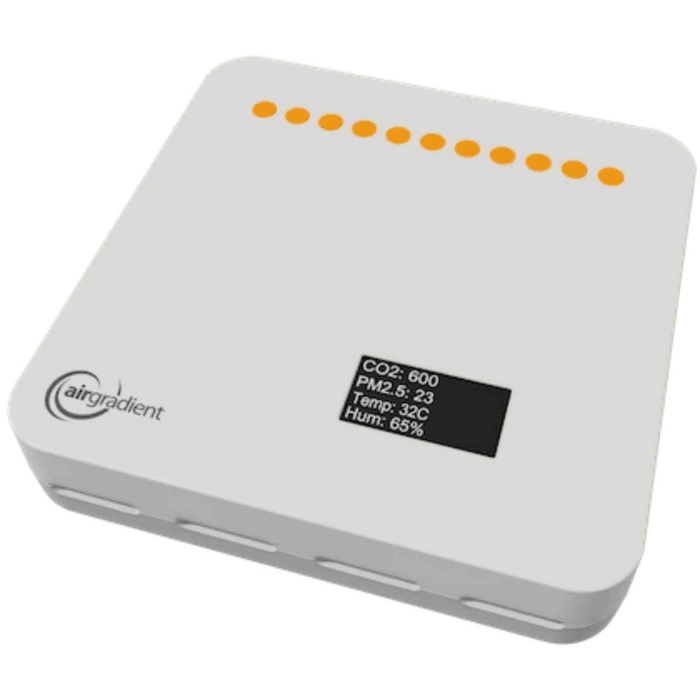
The AirGradient ONE is an indoor monitor listing PM2.5, CO₂, VOC/NOx indices, temperature and relative humidity. Choose it for those measurements, rather than expecting it to clean the air or identify every pollutant.
Check current availability, power, Wi-Fi, placement and dashboard or service terms for the version supplied. See the manufacturer’s sensor overview and ONE setup guide.
What do the readings mean?
- PM2.5: fine airborne particles
- A particle measurement. It answers a different question from a gas sensor.
- CO₂: carbon dioxide
- A separate gas measurement. Do not confuse it with carbon monoxide (CO), or assume a particle filter addresses it.
- VOC and NOx indices
- Signals related to volatile organic compounds and nitrogen oxides. These indices indicate changes, not a complete chemical analysis or a verdict that the room is safe.
- Temperature and relative humidity
- Read them together when considering comfort and moisture. Understanding changes over time is more useful than relying on one snapshot.
The ONE is intended for indoor use. It does not replace a dedicated smoke or carbon monoxide alarm, and a monitor does not remove moisture or repair the cause of damp.
4. When is the EcoAir DD1 a useful option?
Shortlist the EcoAir DD1 Classic MK6 when excess moisture is the issue and you need a desiccant model with a stated cool-room operating range. It is a different purchase from a purifier: compare extraction conditions, drainage and running power, not particle CADR.
The DD1 Classic MK6 is rated at 7.5 litres per day at 20°C and 60% relative humidity, with a 2-litre tank. EcoAir lists an operating range of 1–40°C. Extraction will not be 7.5 litres in every room or at every temperature.
Tank size is not daily extraction capacity. Decide whether emptying the tank suits your routine or whether a suitable continuous-drainage arrangement is practical. Follow the manual’s installation requirements.
Compare another model when: its tested performance at your room temperature, drainage arrangement or running cost is a better fit. Read power consumption alongside extraction conditions rather than assuming all “litres per day” ratings are directly comparable.
Source: EcoAir DD1 Classic MK6 specifications. Product options and delivery terms are those on the YWPA listing, not the manufacturer’s direct-store offer.
A dehumidifier is not a repair for a leak or building defect, and a purifier does not solve the underlying moisture problem. The UK government’s damp and mould guidance explains why the cause needs to be addressed.
5. How do I compare mattresses and bed frames?
Compare the feel, construction and exact materials of the option you are buying. “Natural”, “organic” and “vegan” are not interchangeable descriptions. A claim about a cover or one component does not necessarily describe the whole mattress.
| What matters to you? | What to compare | What to ask |
|---|---|---|
| Firmness and feel | Your current experience and the construction of the shortlisted model. | How does this model differ from the others in the range? |
| Material preferences | Core, comfort layers, cover composition and component-specific certification. | Which exact component is organic or certified? Does the selected cover include wool? |
| An existing bed frame | Internal dimensions, support system and mattress requirements. | Is this mattress compatible with my current base? |
| A complete bed system | What is included, total height, assembly and delivery access. | Am I buying a frame, a base, a mattress or a configured system? |
One example: Demko DeLuxe D
The Demko DeLuxe D listing describes coir and latex construction with alternative covers. The Vegan Cover is listed as Tencel + PES; the other listed cover includes organic cotton and wool. Choose the actual cover option that matches your preferences, rather than treating the product title as the specification for every variant.
A firmer mattress is not automatically the right choice for everyone. Ask about construction, base compatibility and applicable returns terms before ordering. This guide does not promise relief from pain or a particular sleep outcome.
6. Is a sit-stand desk worth it for my home office?
Choose an adjustable desk when you will use its height range; choose a fixed desk when one well-fitted working position meets your needs. An electric mechanism adds little value if it will never be used. Check the chair, screen position, knee space and equipment together.
| Your situation | Our starting recommendation | Confirm before buying |
|---|---|---|
| You want to alternate positions, or share between different-height users | Compare the Flytta STUDIO, a dual-motor, three-stage sit-stand desk. | Required height range, selected top, equipment load, cable reach and assembly. |
| You want a fixed working surface without powered adjustment | Start with a writing desk. | Working height, usable depth, knee clearance and space for a screen and keyboard. |
| Space is tight or you use several screens | Choose by actual desktop size and room layout before choosing the mechanism. | Monitor-arm compatibility, chair movement, door swing and space behind the desk. |
The Flytta listing includes different desktop sizes, including 1200 × 700 mm and deeper 800 mm options. Compare the selected top, not the largest size shown in the range. Height adjustment is not a substitute for a well-set-up workstation or changing your activity.
Use the HSE’s workstation guidance to check screen, keyboard and seating positions. This is a furniture comparison, not a promise to prevent or treat back pain.
7. How do I choose furniture that fits everyday life?
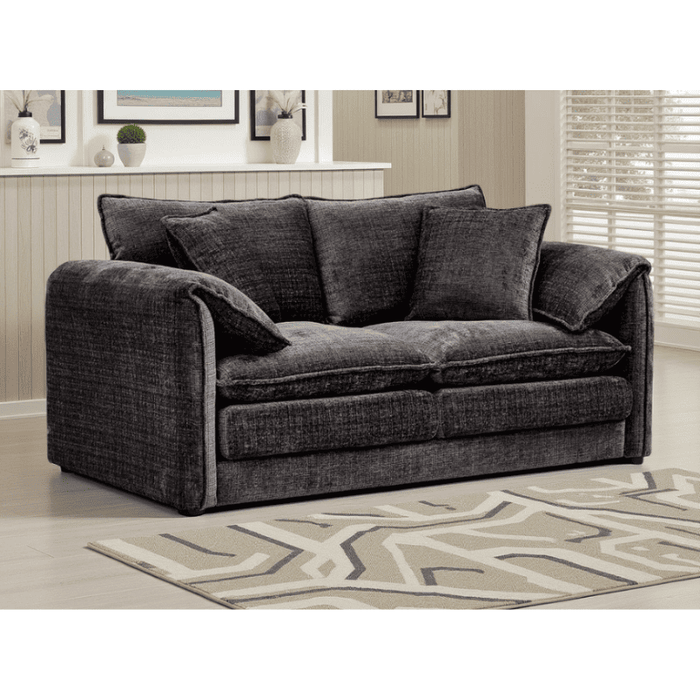
Measure the furniture’s footprint and its entire delivery route. Think about doorways, stairs, landings, lift access and the space around the piece once it is in place.
The Solaya two-seater chenille sofa listing gives dimensions of 178 cm wide × 97 cm deep × 92 cm high. Mark out the footprint to judge circulation space. These are product dimensions, not a promise that the packaged sofa will pass through a particular doorway.
Compare upholstery care and seating style with your household. For a recliner, allow for the mechanism’s clearance and power supply; a static sofa has different space requirements.
Choosing for an outdoor space
Start with the available footprint, intended use and storage. For patio heaters or fire pits, check the exact model’s designated location, clearances, fuel or electrical requirements and instructions. Outdoor equipment should not be treated as an indoor heating solution.
Finish, durability and maintenance claims are product-specific. Do not assume every item across a collection has the same weather resistance or material certification.
8. What will the product cost to own and receive?
Compare the whole ownership cost
For an electrical product, use its power at your intended setting and your own electricity tariff. Then add compatible filters and any other consumables or services.
Electricity cost = watts ÷ 1,000 × hours × price per kWh.
At an illustrative 60 W for 8 hours daily and £0.25/kWh, the electricity cost is £0.12 per day, or £43.80 for 365 days of the same use.
These are calculation assumptions, not a current tariff, measured operating cost or annual quote for either purifier. Power can change with the operating setting.
Your first-year budget: selected product + delivery or assembly + electricity + replacement filters or other consumables. Price a complete filter change for the exact package, not just one accessory. Follow the replacement guidance for your use rather than assuming a universal annual interval.
Check the item and delivery service
Use the product page for current variants and prices, and the shipping policy for delivery information. Ask about your postcode, lead time and access restrictions before ordering a large item.
Confirm what delivery includes: kerbside or room placement, assembly, packaging removal and any additional charges. Do not assume every supplier offers the same service.
Read the refund and returns policy and product-specific terms. Check your selected mattress cover, size or furniture configuration; do not assume a trial period or free collection unless expressly offered.
Your final five checks
- Exact item: model, variant, colour, cover, size and what is included.
- Fit: room dimensions, operating clearances, delivery route and compatibility.
- Daily use: controls, noise, care, maintenance and accessibility.
- Full cost: selected price, delivery, assembly and ongoing consumables.
- Aftercare: warranty scope, returns terms and support contact.
9. Questions that help you make the final choice
How do I choose between the SA600 and Blast Mini for my room?
Start with the side-by-side comparison. The SA600 is the compact starting option; the Blast Mini offers higher maximum clean-air delivery in a heavier wheeled unit. Calculate your room volume and ask about performance at the fan setting you will use. Neither model is automatically the better choice for every bedroom or living room.
Can one air purifier serve my bedroom and living room?
Do not assume one portable purifier will clean separate rooms effectively at the same time. Moving it changes where it operates; it does not provide simultaneous filtration in both rooms. For an open-plan area, size for the connected space. For separate rooms used at the same time, consider room-by-room requirements. The EPA guide describes portable units as intended for a single room or area.
Do I need the carbon-filter package?
Choose by the pollutant you want to address. HEPA filtration is for particles; an appropriate activated-carbon filter is for certain gases and odours. Carbon performance is not described by particle CADR. Both the SA600 and Blast Mini have package choices here: check the selected option rather than assuming carbon is included.
Should I buy a monitor as well as a purifier?
Only when the measurements would help you understand your room or track changes. A monitor measures; it does not filter. Check whether you need particle, CO₂, humidity or other readings before choosing. The AirGradient ONE section explains the difference between its sensors.
Will a purifier or dehumidifier get rid of the cause of mould?
Neither repairs the underlying cause of persistent damp. A purifier filters particles; a dehumidifier removes moisture from air. Investigate leaks, building defects or other sources of moisture rather than relying on equipment alone. See the damp and dehumidifier guidance.
What should I budget for electricity and replacement filters?
Use the running-cost calculation with the relevant operating power, hours and your tariff. Add the current cost of a complete compatible filter change, including carbon when used. Replacement frequency depends on the instructions and conditions of use; the guide does not assume every filter lasts exactly a year.
Does an organic mattress automatically have a vegan cover?
No. The Demko DeLuxe D has a “Vegan Cover (Tencel + PES)” option and an “Organic Cotton and Organic Wool Cover” option. Check every material requirement against your selected variant. A claim about one component does not certify every component of the mattress.
Is a sit-stand desk better than a fixed desk?
It is more useful when height adjustment solves a real need: changing position or accommodating different users. A suitable fixed desk can be the simpler choice when adjustment is unnecessary. Start with your working height and equipment, then use the desk comparison.
What measurements do you need before I order a sofa?
Measure the available floor space and the delivery route: doors, halls, stairs, turns and lifts. Ask for packaged dimensions and information about removable parts where access is tight. Product width alone cannot establish whether delivery will work. See the Solaya example.
Are the products, stock and delivery times fixed in this guide?
No. These are buying examples, not a stock feed or quotation. Check the linked product page and selected variant for current price and availability, and ask us to clarify delivery before ordering when timing is important.
How can I get a more useful product recommendation from your team?
Send your room measurements, intended use, postcode, budget and the priorities that matter most. Include any shortlisted model or exact variant. For furniture, add access restrictions; for purifiers, add ceiling height and noise preferences. Use the enquiry checklist below.
10. Our sources and how to use this guide
Product specifications are drawn from the linked YWPA listings and manufacturer information. Package names and materials refer to the options sold here. The comparisons are our buying guidance based on those specifications, not independent testing, medical advice or a guarantee of a particular result.
Use this dated guide to build a shortlist, then check the current product page, manufacturer instructions and selected variant before ordering. When a specification or package description is unclear, ask us to clarify it rather than assuming two similar products are identical.
- Smart Air SA600 and Blast Mini Mk II: manufacturer specifications.
- AirGradient ONE: sensor capabilities and limitations.
- EcoAir DD1 Classic MK6: extraction conditions, tank and operating range.
- EPA air-cleaner guide: general filtration and sizing guidance, not an endorsement of our products.
- HSE workstation guidance: screen, keyboard and seating setup.
- UK government damp and mould guidance: addressing underlying causes.
Tell us about your room, not just the product
Copy these details into your enquiry so the team has a useful starting point:
- My main goal: what I want to understand or change.
- My room: length, width and ceiling height; whether it connects to other spaces.
- My routine: where and when I will use it, including noise preferences.
- My shortlist and budget: exact models, variants or materials I am considering.
- My delivery: postcode, required timing and any stairs, narrow doors or other access restrictions.
For a desk or mattress, include the dimensions and compatibility requirements of any equipment or bed base you are keeping.